What to give your wedding caterer: the final headcount, allergies and the sheet
Final headcount, allergies, cocktail hour: what to hand your caterer and when, the table-by-table sheet Tablee makes, and a free blank template.

Guides tell you how to choose a caterer, and almost none tell you how to talk to one. Yet once the quote is signed, what matters is what you hand over: five pieces of information, by a set date, in writing. Tablee, our product, builds the table-by-table sheet from your seating chart, and this page works just as well without it.
The caterer sheet builds itself in Tablee
Everything a caterer asks for fits on one sheet, sorted by table. In Tablee, it is produced from your seating chart, so you retype no names.
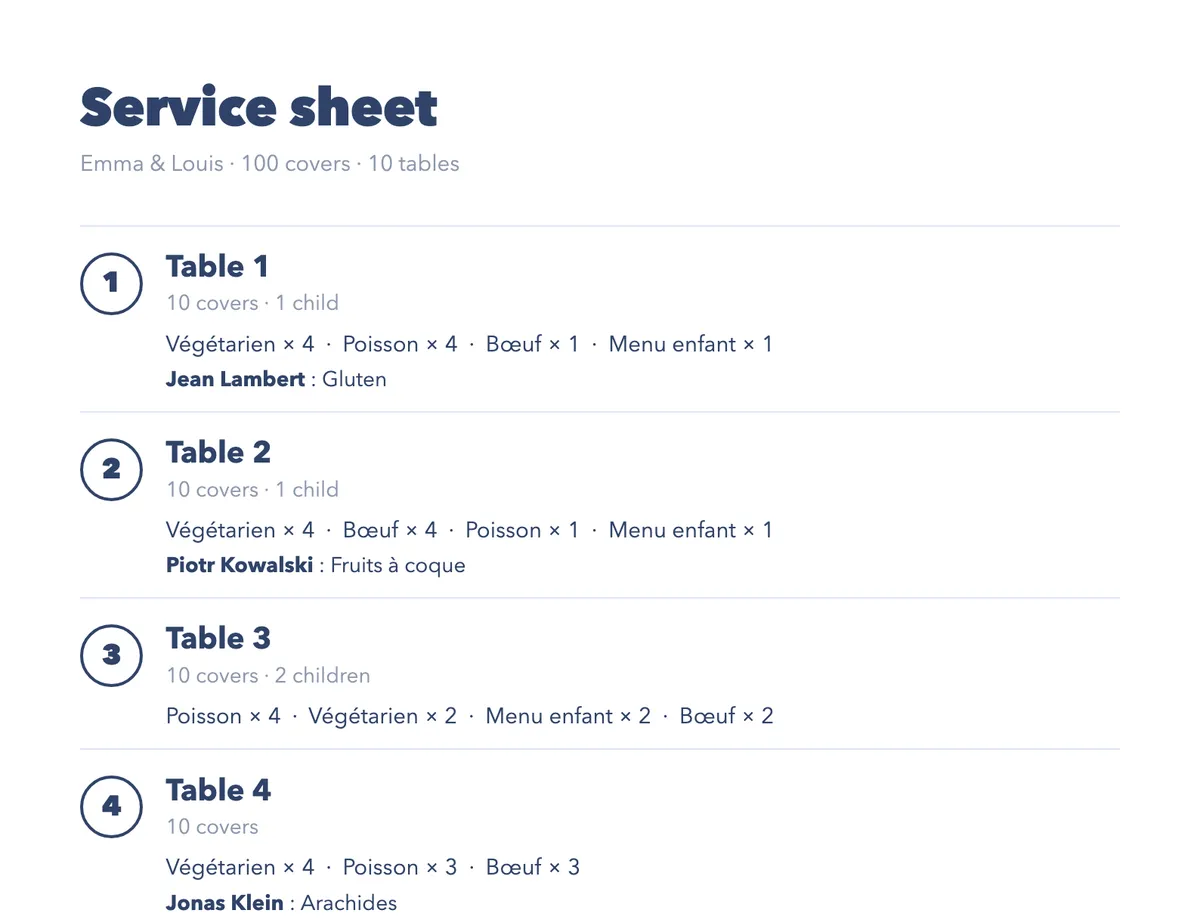
For each table, the sheet gives the number of guests, the children, the meals counted, and the allergies with the guest’s name. That is the order in which a caterer serves: one table after the other.
The path. You paste your guest list, with its meal and allergy columns (from Excel, a CSV, a PDF or plain text). You set your rules and build the chart. In the Documents tab, you choose “Print / Save as PDF”. To build the chart itself, see the full method for making a seating chart.
The deciding argument: a cancellation. After the caterer’s headcount date, someone cancels. You remove the guest, the chart recalculates, and the sheet follows. You send the caterer the table that changed, not a new spreadsheet to check line by line.
Prices, plainly. It is free for one event up to 5 tables: the documents carry a “Made with Tablee” line. 9.99 € once removes the line and goes up to 200 tables, for that event.
What Tablee does not do, to be upfront. The sheet gives meals and allergies per table, not a total per dish. It does not handle the quote, the choice of a caterer, or guests who attend only the cocktail hour. And it has a single graphic style.
Create my free account Sign in
No chart yet? The blank caterer sheet is free, with no account or email: one row per table, plus the list of 14 allergens. It is one of the templates to print.
Your caterer does not ask for a seating chart: they ask for five numbers
You might think the caterer needs the seating chart. They use it for service, but what they prepare and what they bill are five pieces of information. A mistake on one costs more than a seating mistake: one meal too many, one too few, or a forgotten allergy.
| What to hand over | In what form | Date guidepost |
|---|---|---|
| The final headcount | One number, adults and children apart | By the contract date |
| The meals by choice | A count per dish (beef, fish, vegetarian), and the kids’ meals | With the headcount |
| The dietary needs | Vegetarian, vegan, halal, kosher, gluten-free, diabetic: the number and the names | Early, as soon as you know |
| The allergies | The guest’s name, the exact allergen, the severity (traces included), their table | A first list early, the final list with the headcount |
| The service timing | The time, the number of tables, the tables to serve first | With the final list |
The dates are guideposts: the truth is your contract, and your caterer is the one to confirm it.
Adults and children apart
A child eats less than an adult, often from a separate menu, and some contracts price them differently. One merged “guests” number mixes two quantities: the caterer can no longer adjust portions or apply a kids’ meal.
One list, in writing, dated
Send one sheet, dated, and send the updated version at every change. A phone call or a text scatters the information: on the day, nobody knows which version is the right one.
The final headcount: the date after which every no-show can be billed
This is the date that structures everything else. It depends on your list: see how to build it and track replies. Guides usually place the final count at 7 to 14 days before the event, with RSVPs closed one to two weeks before that so you can chase the stragglers. Some contracts are stricter: one hotel package we found asks for the guarantee four business days ahead, and says it may not be reduced.
Three points to check in yours:
- What is billed after the date. Many caterers bill the guarantee, or the actual attendance if it is higher. Ask whether the number can go down at all, and whether there is a grace period.
- The buffer. Sample contracts mention a small buffer above the guarantee at no charge (5 to 10 percent in the ones we saw). Extra guests are usually billed at the menu price. Ask for that price in writing.
- Who counts as a meal. Your DJ, photographer or planner may need a meal, and some contracts include vendors in the headcount.
For guests who did not answer after the reminder, one guide suggests assuming they are not coming, for the chart and for the order. Discuss it with your caterer, because it is a bet. For the full timeline, from draft chart to final chart, see the full method for making a seating chart.
Allergies and dietary needs: what to write, and what the caterer must do
An allergy is flagged in writing, with four elements: the guest’s name, the exact allergen, the severity (traces included) and their table. Ask the caterer to confirm they took it into account. A vague “gluten-free” is not enough: oats, a thickened sauce or breadcrumbs are different questions.
The legal framework depends on where you marry. In the EU, Regulation 1169/2011 lists 14 allergens in Annex II that businesses must be able to flag. In the US, the law names nine major allergens, and its labeling rules mostly cover packaged food, so a caterer’s obligations are not the same as a grocery label’s. In both cases, ask your caterer what they track, how they tell guests, and how they handle cross-contact. Many kitchens cannot promise an allergen-free environment.
The allergens to know
The EU’s fourteen are gluten cereals, crustaceans, eggs, fish, peanuts, soy, milk, tree nuts, celery, mustard, sesame, sulphites, lupin and molluscs. The US nine (milk, eggs, fish, crustacean shellfish, tree nuts, peanuts, wheat, soy, sesame) all fall within them. Tablee’s sheet follows the EU list.
A severe allergy: what the sheet does not replace
A severe allergy is settled in person, with the caterer and the venue. Ask that a named person knows about it on the day, and note their phone number. Ask for an ingredient list for the dishes, which you can show to the guest beforehand. The sheet is the written record of the conversation, not its replacement.
Kids’ meals
Ask whether there is a kids’ meal, from what age, and which allergens it leaves out. If a child has an allergy, put it on the sheet as you would for an adult. Some guides also suggest asking for the child’s age on the RSVP.
The cocktail hour: count the cocktail guests, not the dinner guests
The cocktail hour sometimes receives more people than the dinner. If you invite guests to one and not the other, the caterer needs two numbers. If you give only one, the drinks and the appetizers are sized on the wrong one.
A simple method: keep a second list for the cocktail hour only, with its own guests and the same RSVP tracking, and give the caterer the cocktail total and the dinner total. Tablee does not yet handle a “cocktail only” status, so a separate list will do.
Here are the guideposts guides cite. They differ from one source to another, so take them as a range to check against your caterer’s own rule.
| Topic | What guides say | Worth knowing |
|---|---|---|
| Duration | 45 to 60 minutes before a sit-down dinner | Longer if portraits or the ceremony run late |
| Drinks | About 1.5 to 2 drinks per guest for an hour | 1 for an older or quieter crowd, up to 2.5 for a young summer crowd |
| Appetizers | 3 to 6 pieces per guest for the hour before a seated dinner | The numbers climb a lot if the cocktail replaces the meal |
| Bar staff | One bartender per 75 guests for beer and wine, one per 50 for a full bar | One guide’s figure: ask your caterer for theirs |
| Non-alcoholic | Water and soft drinks | For kids and drivers |

Questions to ask before you sign
Guides list the criteria for choosing. Here are the ten questions about numbers and dates, to ask in writing:
- What is the final-count deadline, and is it a hard cutoff?
- Is the guarantee reducible, and is there a grace period?
- Am I billed on the guarantee, or on the actual attendance if it is higher?
- Is there a buffer above the guarantee, and at what percentage?
- What is the price for guests added after the deadline?
- Do vendors, kids and staff count as meals, and are kids priced differently?
- How do you handle dietary needs and allergies, and how do you want to receive them?
- When is the menu locked?
- Is the equipment included, including without an on-site kitchen?
- What are the deposit schedule and the cancellation terms?
Compare quotes line by line, on the same basis: same number of guests, same drinks, same services. The headline packages do not always include the same things.
On the day: one sheet in the kitchen, one person in the room
Give the sheet to three people: the caterer, their banquet captain, and a trusted friend (a member of the wedding party, for example) who knows where it is. Agree in advance on a discreet marker for special plates, a small sign on the plate or a different napkin, rather than an announcement at the table. Remind the catering staff about the severe allergy again on the day, and do not forget late-night food.
If someone cancels at the last minute, do not start over: tell the caterer about the one table affected. And keep their day-of phone number, not only the salesperson who signed the quote. For printing the documents, see the templates and sizes.
If you want to see how the five pieces of information fit together, you can also build your seating chart online: the sheet is in the Documents tab.