Wedding seating etiquette: who sits where, from parents to the wedding party
Parents, stepparents, wedding party, kids, singles, exes: for each case, where to seat them, an alternative and the trap to avoid.
You are told to “keep everyone happy”, and almost nobody says where to put each person. Here is, for every situation, the seating we recommend, an alternative and the trap to avoid, from divorced parents to coworkers. These are customs, not laws: Tablee, our product, helps you apply them, and this page works perfectly well without it.
Who sits where: the decision table
The table sums up thirteen situations. The last column matters as much as the first: charts rarely fail because of a wrong choice, they fail because of a trap nobody saw coming.
| Case | Recommended seating | Alternative | Avoid |
|---|---|---|---|
| Parents together | At a parents’ table next to the head table, or at the head table | A family table with the grandparents | The back of the room, near the speakers |
| Divorced parents | Two tables of honor, same row, same distance from the couple | Rotating seats: two empty chairs at each table | Neighboring tables facing each other; one parent closer than the other |
| A parent’s new spouse | With their partner, at that parent’s table | At the head table if they raised you | Alone among the ex’s relatives |
| Half- and stepsiblings | With their parent and stepparent when young | A family table with all the siblings | Making them the go-between |
| Grandparents | A calm, accessible table close to the couple | The parents’ table | The back of the room, or next to the DJ |
| Maid of honor and best man | Near the couple, with their dates | A table of their own next door, from five attendants up | Splitting an attendant from their date |
| Siblings | At the head table or the parents’ table | With their friends, if they prefer | Overlooking them for more distant guests |
| Young kids | With their parents | A kids’ table if four or more know each other, with an adult | One child alone at the kids’ table |
| Teens | Their choice: ask | With the young adults in the family | Putting them with the little ones |
| Singles | Among people they know, at a mixed table | Next to another guest from their circle | A “singles table” |
| Coworkers | A bridge table of friends and coworkers | Two or three per friends’ table | One coworker alone among strangers |
| Plus-ones | Next to their partner, with their partner’s group | Same table as the friends who know both | An all-plus-ones table |
| A guest’s ex | Different tables | A buffer table between them | Telling them on the day |
To build the chart itself (count the households, set the rules, fill the tables), see the full method for making a seating chart. Here we settle the cases.
Divorced parents and blended families: the trap is the table next to it
In the US, parents often have a table of their own near the couple rather than a seat at the head table, which already helps. The real risk is somewhere else: the table next door. Two tables of honor side by side put the exes face to face for the whole dinner, in every group photo, with no way out. Seating them apart only works if the tables are apart.
None of this means a shared table is always wrong. If your parents get along, or only their marriage ended, put them wherever you like. The question to ask is simple: will each of them spend four hours comfortable, in view of everyone, near the other?
Two tables of honor, same row, same distance
The most soothing answer is same importance, same distance. Two tables of the same size, in the same row, at the same distance from the head table, served in the same order, with the same number of seats. Each parent sits there with their current partner and their own people: siblings, old friends.
Avoid
Neighboring tables, face to face all dinner
Prefer
Same importance, same distance, friends in between
Rotating seats: two empty chairs at each table
If you want time with each parent, keep two empty chairs at each parents’ table. You and your spouse sit there between the entrée and the dessert, so you never have to choose one table over the other for the whole dinner.
Stepparents: with their spouse, never “as a punishment”
A remarried parent sits with their new spouse, not with the ex. Putting the new spouse alone among the former partner’s relatives feels like a punishment, even when nobody meant harm. A stepparent who raised you belongs close to you; one who joined recently sits with their partner at the parent’s table. Children of the new couple stay with their parents: a nine-year-old has no use for a diplomacy that is not theirs.
Buffer tables, and the tables that really are neighbors
If the room is small, slip one or two buffer tables of friends between the two parents, as in the plan above. Check it on the room plan, not in your head: two tables that look far apart in a list can be elbow to elbow on the floor.
Adult children are not mediators
Do not seat a brother or sister between the two families to “bridge the gap”. Place everyone according to their real ties: with the parent they see most, with their cousins, with their friends. A human buffer always ends up exhausted.
The chair math
Two family tables create a problem nobody counts: the chairs to fill. Two tables of 8 for two families of 6 leave 4 seats to fill. Fill them with relatives and friends of the parent concerned, never with the first strangers available, and keep 2 chairs per table if you want rotating seats.
The head table: who sits there, and to the left of whom
The head table can take four shapes. The choice depends on the room, the headcount and, above all, on what you want to avoid.
Long table
U-shaped table
T-shaped table
Sweetheart table and wedding party table
Sweetheart table, wedding party, or family table
A sweetheart table seats the couple alone, in full view, with a table for the wedding party beside it. A wedding party head table puts the couple in the middle, flanked by their attendants. A family table seats the couple with their parents: it works when everyone gets along, and it is the first thing to drop when they do not.
Parents and grandparents: near the couple, with no visible ranking
If your parents get along, two simple options: a shared table of honor next to yours, or two family tables nearby. Give each side the same number of seats and the same proximity: a family placed closer than the other is noticed, and talked about. Grandparents benefit first from a calm, accessible, nearby table, where they sit with their children without crossing the room.
The wedding party, with their dates
An attendant seated near the couple can give a toast without leaving their chair, and their date is not stranded at the other end of the room. From five or six attendants up, a table of their own next door keeps the head table from stretching into the absurd.
To the left of whom? From the room or from the couple
Etiquette guides disagree on which side is whose, partly because “left” depends on who is looking. Nothing here is mandatory. What matters is being clear with the caterer: write “as seen from the room” on the plan you hand over, or the floor manager may flip the two sides. In our diagrams, the bride is on the left, as the guests see it.
Every seat creates someone left out
For each person at the head table, someone else is not. Choose by the role played that day (attendants, hosting parents) rather than by length of friendship, then say so plainly: “we kept this table for the people giving toasts.” One clear sentence soothes better than ten vague explanations.
Kids, teens and babies: a table of their own, or with their parents?
The number of kids matters more than their age. With two or three children a table of their own is lonely and nobody supervises it: keep them with their parents. From four or five who know each other, it becomes a treat, if you give it a trusted adult, a kid-friendly meal and something to do.
- The youngest stay with their parents, always.
- Teens choose: ask them. They often prefer the table of the young adults in the family to the little ones’ table.
- Babies: a parent within sight, or the sitter at a nearby table, away from the speakers.
- In a blended family, children stay with their parent and that parent’s spouse, like Lucas in the worked example.
Grandparents and guests with mobility needs: comfort before protocol
For older guests or guests with limited mobility, the criterion is not the prestige of the table but comfort: away from the speakers and the foot traffic, near the exits and the restrooms, on a chair with a back, with a clear path to the table. A grandfather seated at the head table but behind a pillar, next to the speakers, has not been honored.
As a reference, the 2010 ADA Standards for Accessible Design ask for a clear width of 36 inches on an accessible route and a turning space of 60 inches for a wheelchair. Your venue knows its own constraints: ask for its accessibility plan, and choose a specific chair, not just a table number, when someone’s mobility varies.
In Tablee, a guest with limited mobility carries a “Wheelchair” tag, and you can draw the speakers, the exits and the dance floor on the room plan. They are reference points for your eye, not rules: the engine does not move anyone closer to an exit. You have to check.
Singles, plus-ones and coworkers: mixing without creating the leftovers table
There is no good “singles table”. Seat each person among people they know, at a mixed table, with at least one person from their circle. A guest alone among strangers spends the evening looking for a conversation.
- Plus-ones sit next to the person who brought them, with that person’s group. The classic trap is the table where all the newer partners end up together.
- Coworkers: a bridge table that mixes friends and coworkers, or two or three coworkers per friends’ table. A single coworker alone among the family is the classic trap.
- A guest’s ex: two different tables, not neighboring. In a small room, put a buffer table between them. Do not announce it on the day.
- Circles that do not know each other: mix them on a few tables only, so everyone keeps a landmark.
In Tablee, the “Coworkers” group is set to Spread out to share them across all the tables, or Gather to keep them together. In the worked example, the four coworkers ended up at four different tables: check that each one knows someone.
The seats people forget: vendors, the sitter, the officiant
They are not guests, but they eat. Think about them before the caterer’s headcount:
- The photographer and videographer: a vendor meal, served apart or at a table near the exit, so they can stand up without crossing the room.
- The DJ and the musicians: food near their setup, outside the toast times.
- The officiant or the planner: at a guest table, or at the vendors’ table.
- The sitter or nanny: close to the kids’ table.
- Spare chairs: two or three free seats for surprises.
Ask the caterer for the price and the menu of vendor meals when you get the quote: they count in the headcount, and their absence from the chart shows on the day.
At the ceremony: families, sides and front rows
The ceremony is a separate map from the reception. By tradition, Emily Post describes the bride’s parents in the first row on the left, facing the officiant, and the groom’s parents in the first row on the right, with the immediate families behind them. Many couples drop the sides and simply reserve the front rows. With divorced parents, plan the front rows carefully: Emily Post suggests the bride’s mother, with her spouse, in the first row, and her father a few rows back (the third or fourth), with his wife and their family.
The words to announce it: three message templates
A poorly announced seating plan is a failed one, even if it is a good plan. The structure that works has four elements: a positive reason, symmetry, what stays the same, a moment planned with you. Here are three templates to adapt.
What not to say: never “it’s because of so-and-so”, never a comparison between two families, never “we’ll see on the day.” And on the day, hand the chart to someone you trust who can swap two guests without bothering you, with two spare chairs in reserve.
From choice to rule: turning these decisions into a chart
A seating choice becomes a rule when you write it with two names. Here is the translation, in Tablee’s words.
- Two divorced parents at separate tables: “must not sit at the table of”, with Strict rule.
- A new spouse with their partner: both in the same household.
- A child with their parents: the same household, because a household is never split.
- An attendant near the couple: “must sit at the same table as”, Essential.
- A grandparent with their daughter: “must sit at the same table as”, Important.
- A guest’s ex at another table: “must not sit at the table of”, Essential.
- Mixing the coworkers: the group on Spread out.
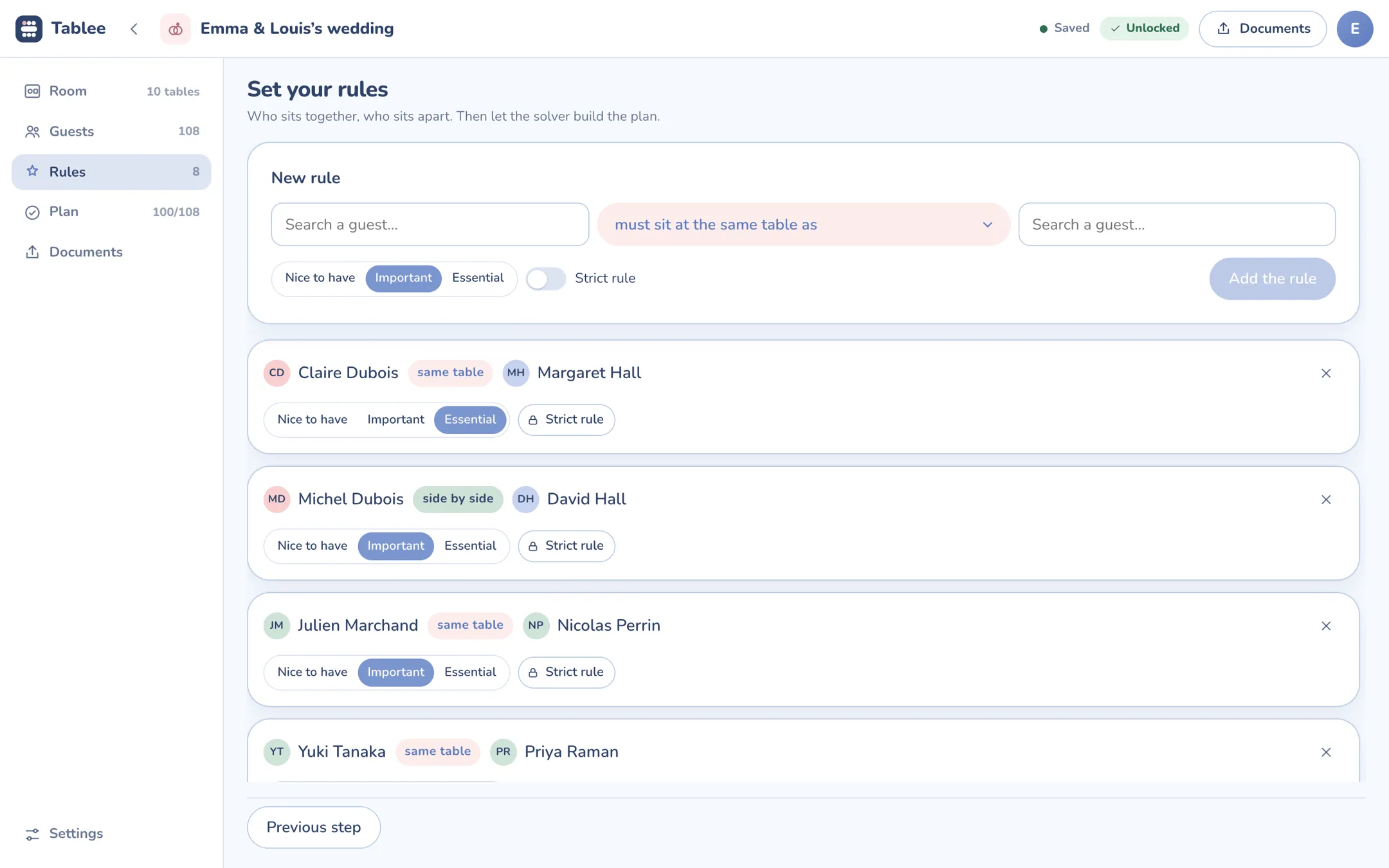
Tablee is free up to 5 tables, with the full seating engine, and 9.99 € once then unlocks the event up to 200 tables. It runs in the browser and on iPhone, with the same account. You can build your seating chart online right now. Its limits, to be honest: it does not handle distances between tables, has no 3D view and no online guest replies.