How to plan a wedding: the order that avoids redoing everything, month by month
In what order to plan a wedding: what blocks what, the month-by-month timeline, the budget, and the forgotten workstream: guest list, seating chart, guests' photos.
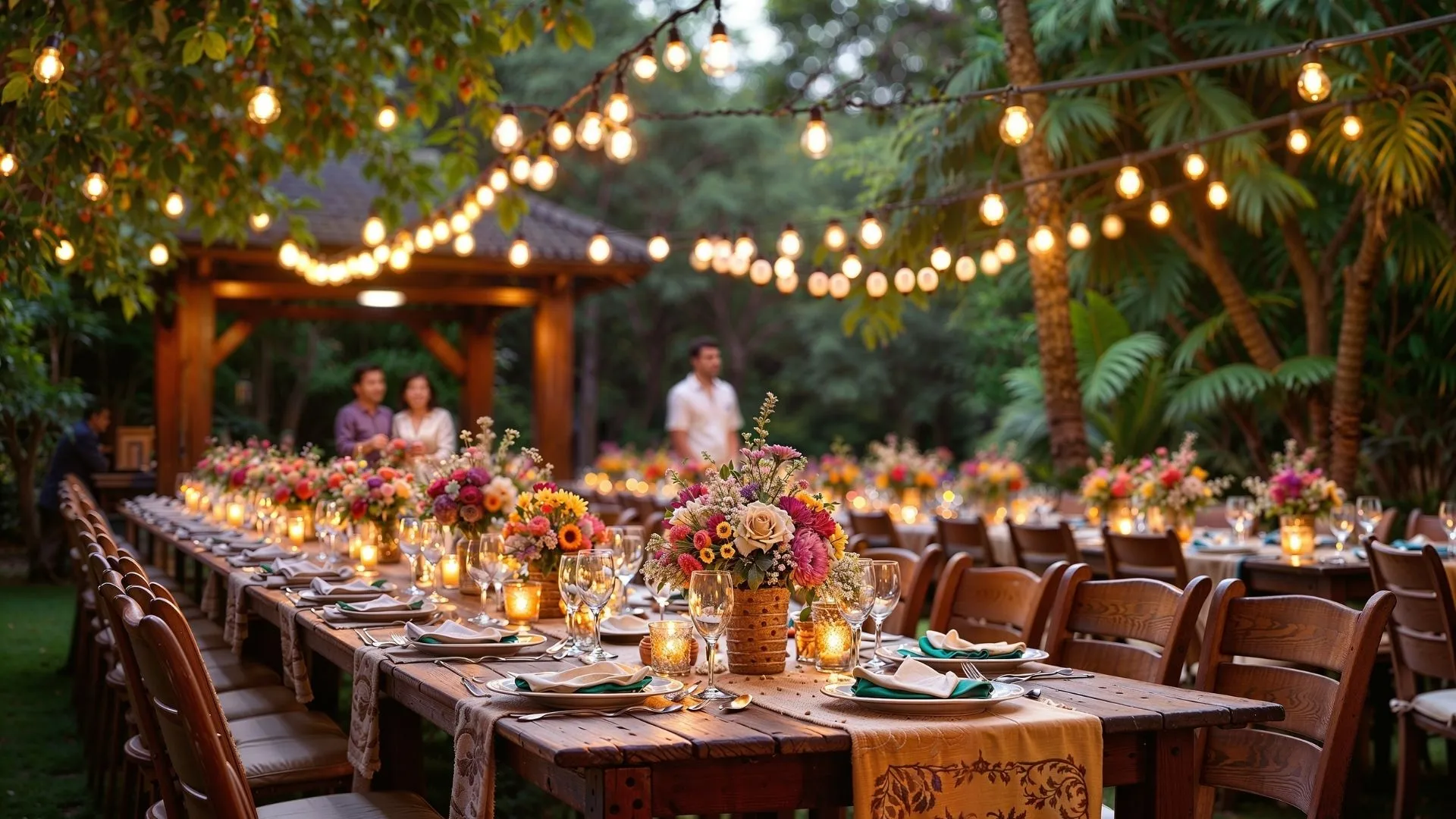
Planning guides give you ten or fourteen steps and rarely say what blocks what. So people tour a venue before they know how many guests it must hold, and redo everything. Here is an order, a month-by-month timeline, and a workstream that the checklists we read leave out: your guests. We publish Tablee (the seating chart) and Film36 (guests’ photos): they are the two tools we discuss, and this page works without them too.
Planning a wedding is not a 14-step list: it is a chain of dependencies
You can do everything in any order, as long as you accept redoing some of it. Most steps depend on another, and three choices block everything else: the date, the budget and the guest count.
| What you decide | What it blocks | What you need first |
|---|---|---|
| The guest count (roughly) | The venue, the caterer, the budget | A rough figure is enough, but you need one |
| The date | The venue, the vendors, the wedding party | Popular venues book 12 to 18 months ahead |
| The budget | Everything else | It is computed with the guest count |
| The venue | The caterer, the décor, real capacity | The date and the guest count |
| Guests’ replies | The caterer’s final headcount | The deadline in the contract |
| The caterer’s final headcount | The final seating chart | The replies |
The three locks: date, budget, guest count
The first number to fix is not the budget: it is the guest count, because it sets both the venue and the cost. The Knot’s 2026 Real Weddings Study (about 10,000 US couples married in 2025) reports an average of 117 guests and $292 spent per guest. Each extra guest adds a plate, a chair and a share of the bar. Draft the guest list before you tour venues, even roughly. To build it: wedding guest list: how many to invite and how to decide.
What can wait
The theme, the attire, the rings and the honeymoon can wait without breaking anything: they block nobody. They are also the first things people settle, because they are the most fun. Keep the order: what blocks first.
The workstream the checklists leave out: your guests
In the two big checklists we read in full, the seating chart is one more line (with no method) and guests’ photos are missing from both pages. Yet these two take the most time in the last weeks. Here are the tools we use for each.
The list, the replies and the seating chart: Tablee
Tablee imports your guest list (from Excel, Numbers or Google Sheets, a CSV, a PDF or text), keeps households together and tracks each guest’s reply. You then set your rules (who sits with whom, who stays apart) and it builds the seating chart and the four documents for the day.
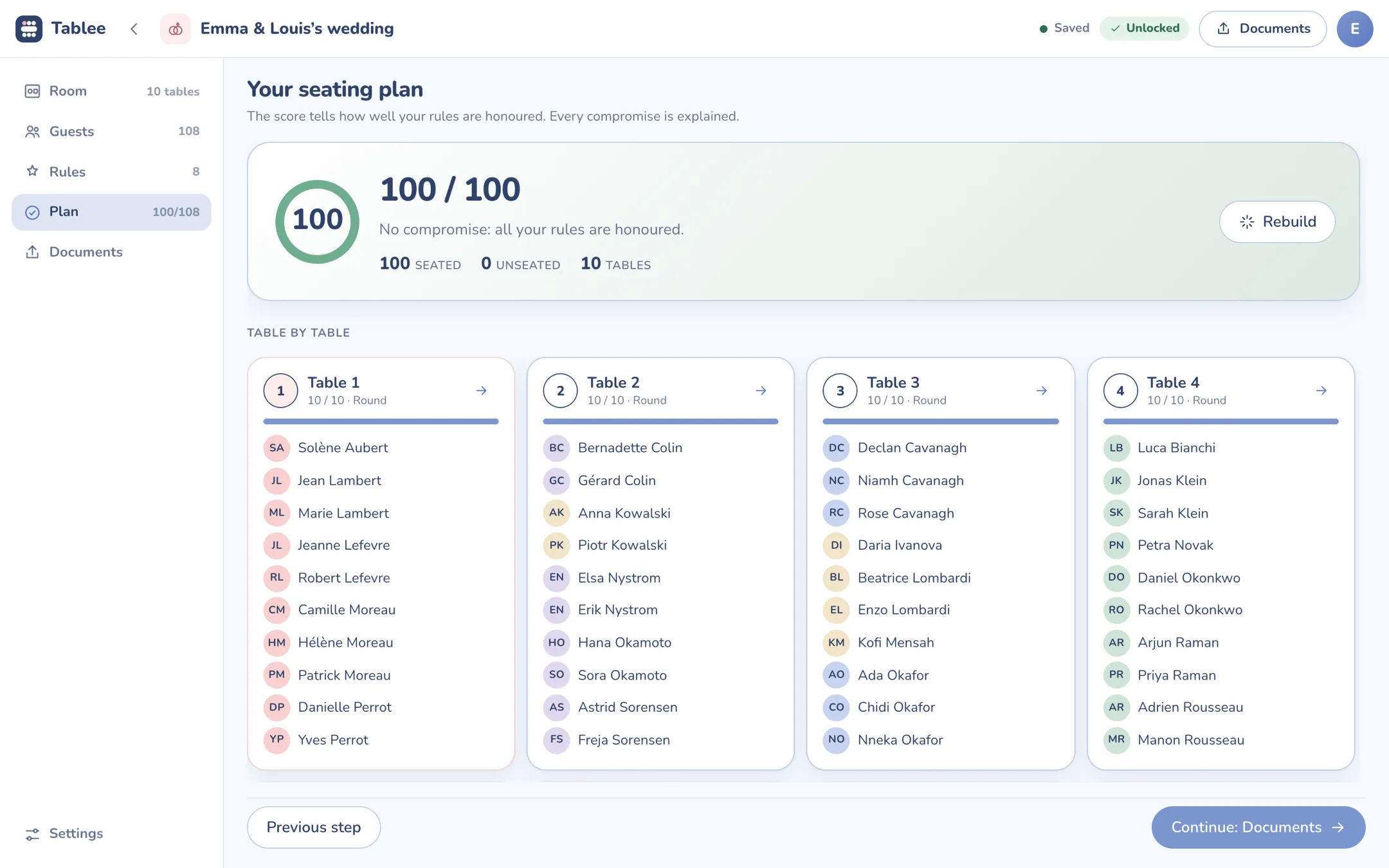
It is free for one event up to 5 tables, with a “Made with Tablee” line on the documents; 9.99 € once removes the line and goes up to 200 tables. What Tablee does not do: it does not write invitations, collect replies or handle photos. See the full method for making a seating chart.
Create my free account Sign in
Guests’ photos: Film36
Your guests take dozens of photos at your wedding, and you will only see a few, squashed into a group chat. Film36 is our other site, built for that: a QR code on the tables, which guests scan with no app and no account.
Film36’s QR code album, in 43 seconds.
- The QR code album. Guests send photos and videos in original quality, even offline, to one album. That night, the photos can slide across a screen. The next day, everything downloads. Free up to 100 photos; €49 for the full album (unlimited photos, videos up to five minutes, kept twelve months).
- The disposable camera. An iPhone app (Android guests use the browser): each guest gets 36 shots, with no preview, and all the photos are developed the next day at 10 a.m. Free for up to 10 guests, €19.99 once up to 1,000 guests.
- The audio or video guest book. Messages of two minutes, up to 500: €19.90 for one format, €24.90 for both. The album and the guest book together cost €59 (€64 with both formats).
Prices are one-time, with no subscription, from Film36’s pricing page as of October 27, 2026. They are in euros. What Film36 does not do: it does not make the seating chart, and it does not replace a photographer. To collect the photos afterward, see how to collect wedding photos from guests; to get guests shooting, the photo challenge ideas.
The month-by-month timeline, with the guest milestones
Guides give lead times that differ from one source to another: treat them as guideposts, and trust your venue and caterer. Here is the order, with our guest milestones added.
| When | What gets done | Guide that goes deeper |
|---|---|---|
| 12+ months | Budget, a first guest list, the date, the venue (especially in high season) | Guest list |
| 9 to 12 months | Photographer, videographer, band or DJ: the best dates go first | |
| 9 months | Caterer tastings, florist, hotel block | Your caterer |
| 6 to 8 months | Save-the-dates | |
| 4 to 6 months | Invitation design and order. Our milestones: write your plus-one and kids rules before you print | Guest list |
| 3 months | Attire, details. Decide how you will collect guests’ photos | |
| 2 months to 6 weeks | Send invitations; replies start. Zola says no later than six weeks | Guest list |
| 3 to 4 weeks | Replies closed, one follow-up | Tracking replies |
| 1 month | Finalize RSVPs and a draft seating chart | The method |
| 1 to 2 weeks | Final headcount to the caterer; seating chart frozen | Your caterer |
| 10 days | Print the room plan and the entrance poster | Printable templates |
| The day before | QR codes on the tables, timeline given to vendors | |
| The day | One person in the room, the sheet in the kitchen | Your caterer |
The lead times come from the guides we read (Zola, Bridebook, and others). They contradict each other at times: one gives seating charts at one month, another at three to six, while the caterer wants the final count a week or two out. The logic is the same: a draft chart at a month out, frozen at the headcount.
The budget: three sources, three numbers, and a method
You read very different figures for what a wedding costs, and few guides say why.
| Source | Average cost | What it says |
|---|---|---|
| Zola Wedding Cost Index | About $36,000 (range $33,000 to $45,000) | Venue about 17% of the budget, catering 14%, photography 9% |
| The Knot 2026 Real Weddings Study | $34,200 | 117 guests, $292 per guest |
| A wedding-cost roundup relaying 2025 data | $15,000 for 50 guests or fewer; $42,000 for more than 100 | Guest count drives the total |
The scopes probably differ: what is included (attire, travel, rings), the year, the region. What does work: your budget divided by what one guest costs. That gives a ceiling for guests, on which the list is built: see wedding guest list: how many to invite. Zola gives shares per category, which is rare: use them as a starting point, not as a rule. Keep a margin too.
Paperwork: what guides skim over
The paperwork depends on your country, state or county, and on your situation. In the US, couples apply for a marriage license, and Zola suggests researching the requirements about six months out. In England and Wales, notice of marriage must be given at least 28 days ahead, though some councils count 29, so check your register office. We do not list dates and documents for every place: ask your local office as soon as the date is set, and check the official site of your authority.
Vendors: in what order to book them
Book by lead time, not by fun. What guides say: the venue 12 to 18 months ahead in high season; photographers, caterers and bands 9 to 12 months; florists and bakers 6 to 8 months. The caterer comes after the venue, because they depend on its kitchen and capacity.
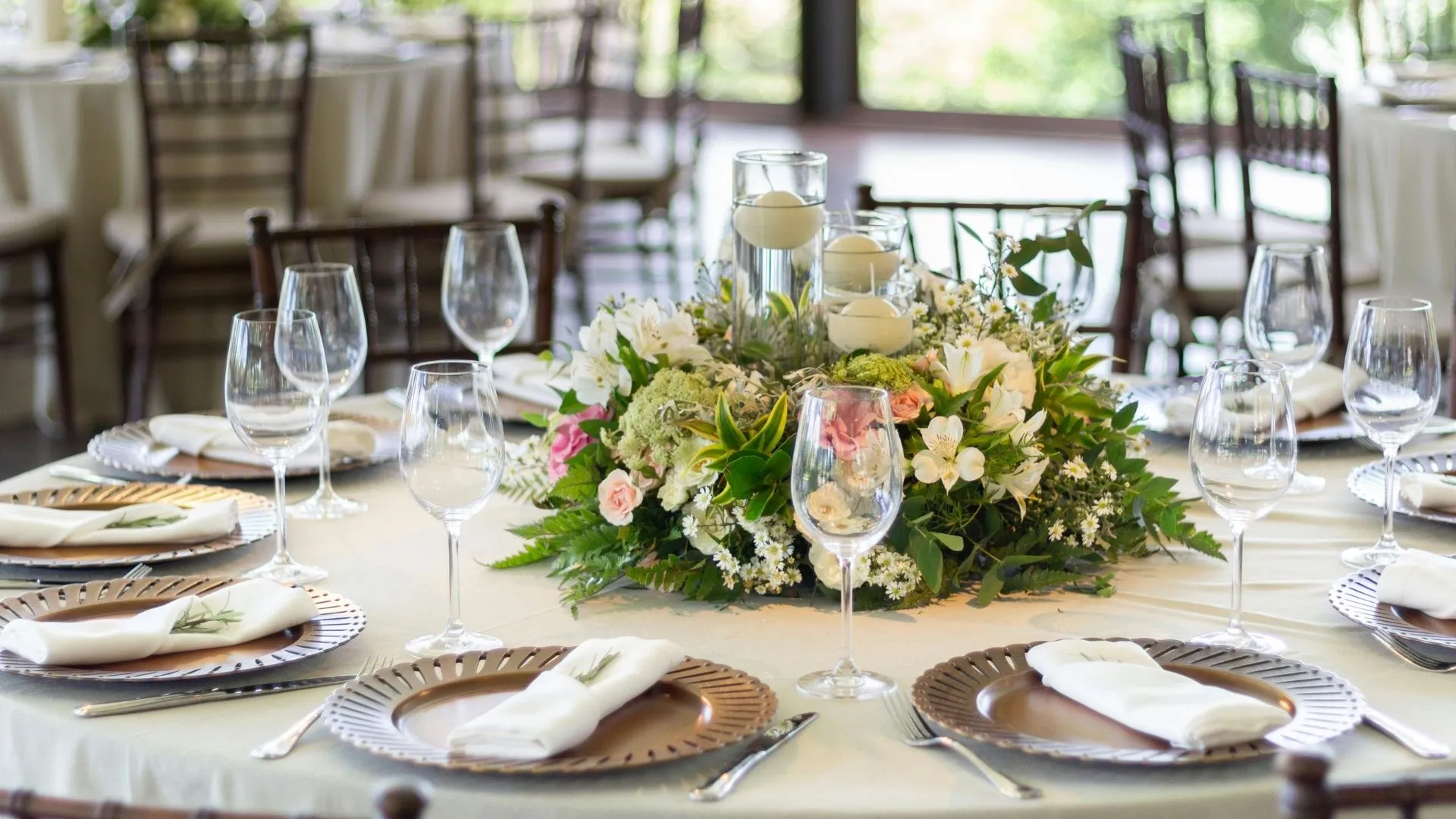
Give each vendor a timeline adapted to their trade: it is the most repeated advice, and the way to avoid mix-ups on the day. With the caterer, the constraint is a date and numbers: the detail is in what to give your wedding caterer.
Wedding party, attire, theme: what can wait safely
The theme, the décor, the attire (fittings come late), the rings and the honeymoon do not block anything else. They matter, but they can be caught up. Choosing the wedding party matters more, because they stand with you at the ceremony: choose them before the paperwork.
The last seven weeks: headcount, seating chart, printing, photos
In the last weeks, everything happens on the guest side.
- Six weeks out: no invitations left to send; the B list, if any, is settled.
- Four weeks out: replies are closed, one follow-up has gone out.
- Two weeks out: the final headcount goes to the caterer, with dietary needs and allergies.
- Ten days out: the seating chart is frozen and you print: templates and sizes.
- The day before: the Film36 QR codes are on the tables or ready, and the timeline is with the vendors.
- The day: a trusted person keeps the chart and the caterer’s sheet.
For the chart itself, see the full method for making a seating chart, and for who sits where, wedding seating etiquette.
The mistakes that cost the most
Five come back again and again. Each has its guide.
- Choosing the venue before counting the guests. You find out too late that the venue cannot hold the list: the guest list.
- Sending invitations without a plus-one or kids rule. “And family” can double the list: the guest list.
- Signing a caterer without knowing the guaranteed count. One fewer guest can still be billed: your caterer.
- Printing before the headcount. One absence changes the poster: printable templates.
- Forgetting to plan for guests’ photos. Once the wedding is over, it is late to collect them: Film36.
If you keep one rule: what depends on guests is prepared early, and what depends on their replies is frozen at the last minute. The rest follows.